
Sorry, no results.
Please try another keyword
In the highly competitive SaaS landscape, customer churn is one of companies’ most pressing challenges. Unlike traditional business models, SaaS businesses operate on recurring revenue, meaning maintaining long-term customer relationships is pivotal for sustainable growth. This makes customer retention a key pillar of success, as retaining existing customers is more cost-effective and provides a reliable revenue stream.
Studies consistently show that increasing customer retention by even 5% can lead to a significant rise in profits, often by 25% to 95%. That means every customer you retain is an opportunity for your company to thrive. Moreover, it’s far cheaper to retain a satisfied customer than it is to acquire a new one—and in the competitive SaaS environment, it’s essential to find ways to optimize your marketing spend. Effective customer retention translates into steady revenue growth, improved customer lifetime value (CLV), and a stronger foundation for scaling the business.
Understanding customer retention strategies can make all the difference between a SaaS company’s stagnation and growth. In this post, we’ll explore actionable strategies that will help boost customer engagement, reduce churn, and foster loyalty—factors that will contribute to the long-term success of your SaaS business.
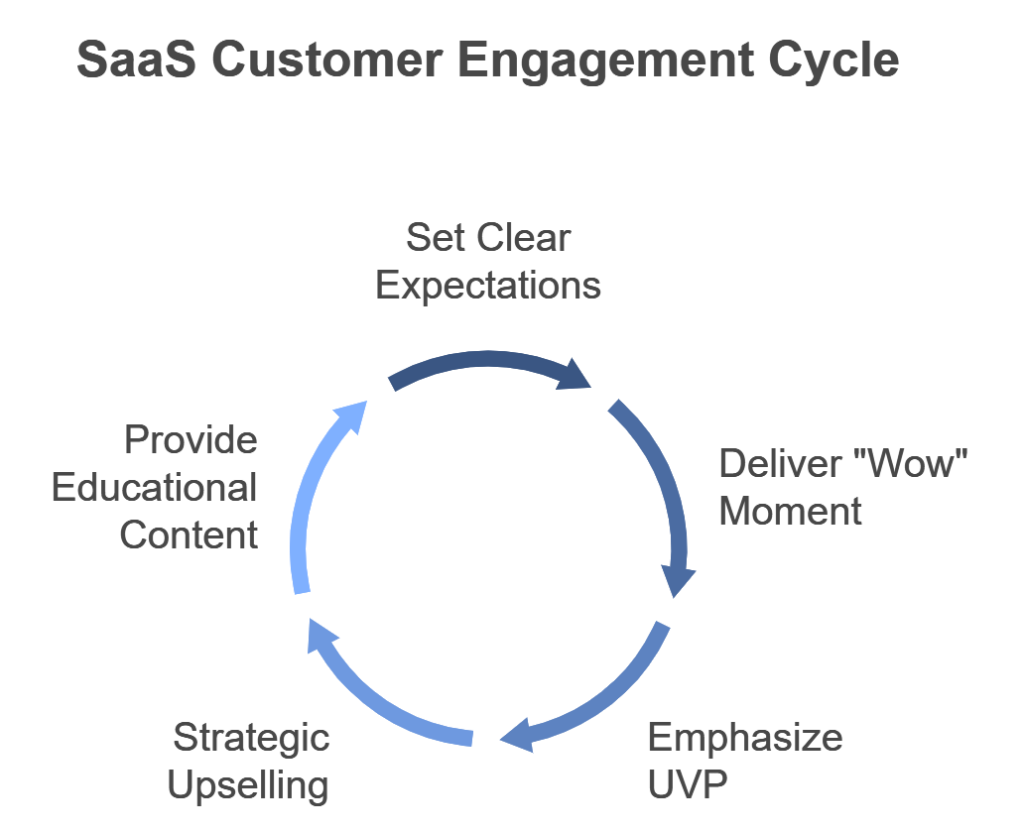
Effective customer engagement plays a crucial role in retaining SaaS users. Engaged customers are more likely to experience the value of your product, appreciate the benefits, and ultimately stay loyal. Below, we’ll cover the key strategies that can help your business boost engagement and improve retention.
One of the main reasons customers churn is unmet expectations. The key to reducing churn is setting clear and realistic expectations from the beginning of the customer journey. This means being transparent about what your product can do, who it’s for, and what kind of experience users should expect. Clear expectations eliminate misunderstandings and ensure customers know exactly what they’re signing up for.
A good rule of thumb here is to underpromise and overdeliver. By providing a product experience that exceeds expectations, you create delighted customers who are far more likely to stick around.
The “wow” moment is when your customer realizes the real value of your products. Think of when your solution perfectly addresses their needs, and they feel they’ve made the right choice. Helping customers reach that moment early in their journey is essential for long-term retention.
You need an optimized onboarding process to guide customers to their “wow” moment. When users sign up, it’s crucial to walk them through the key features that make your SaaS product unique. Onboarding should be smooth, informative, and targeted to the individual needs of your customers.
Additionally, offering free training sessions or personalized onboarding calls can help users understand the product better, especially if it’s a complex solution. By providing support early on, you help customers see value immediately and minimize the risk of churn.
In a crowded market, having a strong Unique Value Proposition (UVP) is critical. It’s what differentiates your SaaS product from the competition and keeps customers engaged. Your UVP should be communicated on your website, in onboarding materials, and throughout the customer lifecycle to remind users why they chose your product in the first place.
Custify, a customer success platform, has mastered this concept. Their homepage emphasizes the specific benefits customers receive from using their solution, backed by social proof and strong calls to action. This messaging helps customers stay connected to the value they initially saw in the product.
When customers understand and remember the unique benefits they’re receiving, they are less likely to switch to a competitor. Make sure your UVP is clear and reinforced consistently throughout the customer journey.
Another powerful way to retain customers is through strategic upselling. Upselling helps deepen customer relationships by highlighting additional features or higher-tier plans that provide added value. When done correctly, upselling boosts revenue and ensures that customers get the most out of your product.
To make upselling effective, focus on the customer’s needs and demonstrate how upgrading can help them achieve their goals more efficiently. Slack, for example, does an excellent job of upselling by showcasing the benefits of their Pro and Business+ plans to customers already using the free version. By emphasizing features like increased storage, enhanced security, and improved collaboration tools, Slack encourages users to upgrade without being overly pushy.
Upselling should always feel natural and value-driven, not forced. Presenting relevant upgrades when customers are already finding value in your product creates a win-win situation that increases customer satisfaction and retention.
Keeping customers engaged often means providing them with ongoing education and resources that help them get the most out of your product. Targeted tips—such as automated emails triggered by specific user actions—can encourage customers to explore features they may not be aware of and deepen their engagement with your product.
The key is to deliver this content at the right time, based on user behavior. When users feel like they are being supported and educated in a way that aligns with their journey, they are far more likely to stick around and continue using your product.
Retaining customers goes beyond engagement—it’s about creating experiences that foster loyalty. Delight keeps customers coming back and motivates them to become advocates for your brand. Below are key strategies for providing customer delight that can significantly improve retention.
Maintaining consistent communication with your customers is essential for keeping your brand at the forefront of your mind and reminding users of the value you provide. Whether through email, phone calls, or social media, regular touchpoints help build a personal connection with customers and foster trust.
Use a mix of communication channels to reach your customers where they are most comfortable. Ensure your messages are timely, relevant, and valuable to their experience.
Another critical aspect of delighting customers is showing that your product is continuously improving and evolving to meet their needs. Customers want to feel like they are using a product that’s growing alongside them, and regular updates are a great way to convey that message.
Actively seek constructive feedback from your customers and use it to guide product development. By implementing features that customers request and announcing those updates, you demonstrate that you value their input and are committed to delivering the best possible experience.
Excellent customer service can be a game-changer when it comes to customer retention. Providing timely, knowledgeable support shows that you care about your customers and their experience with your product.
In addition to traditional support channels, consider offering self-service solutions like a knowledge base, developer hub, or community forum. Self-service tools empower customers to solve their issues independently, significantly improving their experience and reducing frustration. When customers feel supported and capable of successfully using your product, they are likelier to stay with your company.
Implementing loyalty programs is a powerful way to show appreciation for your customers and encourage them to continue using your product. Loyalty programs can include discounts, exclusive access to features, or even tangible rewards like gift cards or branded merchandise.
Rewards programs don’t have to be complex—simple gestures can have a big impact on customer satisfaction. By acknowledging and rewarding your customers’ loyalty, you foster a sense of appreciation and belonging, which helps ensure they stick around for the long haul.
To truly excel at customer retention, practicing proactive listening is essential. Proactive listening involves actively seeking feedback and making sure your customers feel heard and valued throughout their journey. Below are strategies to effectively engage in proactive listening.
Feedback is one of the most valuable tools for improving customer experience. Surveys are an effective way to gather insights directly from customers about what’s working well and where there’s room for improvement. Consider sending out surveys at key moments in the customer journey, such as after onboarding or after they’ve used a new feature.
By acting on the feedback collected, you improve your product and demonstrate to customers that their opinions matter. This creates a positive feedback loop, where customers feel more engaged and valued, leading to greater loyalty.
Building a sense of community among your customers can significantly enhance retention. A community forum allows users to interact with each other, share their experiences, and get help when they need it. It also provides an excellent opportunity for you to listen to customer feedback and understand what’s important to them.
Tracking customer engagement metrics is crucial for identifying customers at risk of churning. Metrics like product usage frequency, feature adoption, and customer health scores can provide valuable insights into how engaged your customers are.
Even when customers decide to leave, there’s an opportunity to learn. Exit surveys provide insights into the reasons behind customer churn, allowing you to identify patterns and make improvements to prevent future losses.
Keep the cancellation process straightforward, but be sure to ask for feedback in a non-intrusive way. Use the insights from exit surveys to make strategic changes that address common pain points and improve the overall customer experience.
To build an effective customer retention strategy, it’s important to track and optimize the right metrics. Below are key retention metrics to monitor:
Net Promoter Score (NPS) measures customer loyalty by asking how likely customers are to recommend your product. A high NPS indicates strong customer satisfaction, while a low NPS highlights areas for improvement.
The churn rate indicates the percentage of customers who cancel their subscriptions. Monitoring churn is critical for understanding how well your retention efforts work and identifying areas needing attention.
Customer Lifetime Value (CLV) measures the total revenue generated by a customer over their entire relationship with your company. Increasing CLV means more value for each customer, which is a key indicator of successful retention strategies.
A customer health score tracks the overall engagement and satisfaction of your customers. This metric combines various factors, such as product usage, support interactions, and customer feedback, to provide a holistic view of your customer relationships’ health.
Monitoring your Monthly Recurring Revenue (MRR) and Annual Recurring Revenue (ARR) helps assess the financial health of your business and the impact of your retention strategies. Increases in MRR and ARR are good indicators of successful customer engagement and retention.
Customer retention is the cornerstone of sustainable growth for SaaS companies. You can foster loyalty and reduce churn by implementing engagement strategies, customer delight initiatives, proactive listening, and ongoing support.
Retaining customers goes beyond simply reducing churn—it’s about creating an experience that makes them want to stay and advocate for your product. By prioritizing customer experience, continuously improving your product, and rewarding loyalty, you can build strong relationships that lead to long-term success.
At JOS, we understand how important customer retention is for SaaS companies. As a digital marketing agency, we specialize in helping businesses develop and execute effective customer retention strategies to ensure long-term growth. Let us help you create an experience that keeps your customers coming back.
Contact us today for a discovery call to see how we can support your retention efforts.

Sean Camilleri is a Digital Marketing & Growth Specialist at Joseph Studios, specializing in SEO, content marketing, and Pinterest strategy. With a background in FinTech risk management, he brings an analytical approach to organic growth — helping brands attract the right audience and turn targeted traffic into measurable results.

Our knowledgeable team is ready and eager to answer your questions. Want to learn more about our company and processes? Looking to explore our subscription services or discuss packaged pricing? Contact us or check out our pricing page to get acquainted.


