
Scaling Your SaaS Business: Challenges and Solutions

In the high-octane realm of Software as a Service (SaaS), businesses are witnessing unprecedented growth trajectories that demand attention and a strategic response. Scaling in SaaS isn’t merely a goal; it’s an imperative for survival and success in a fiercely competitive market. As your SaaS business evolves, the complexities of scaling become more apparent, presenting a blend of significant opportunities and formidable challenges.
Essentials of SaaS Scaling for Growth
Scaling a SaaS business means expanding its capacity to accommodate a growing user base while maintaining or enhancing overall performance and user experience. It’s about ensuring that your service remains seamless and robust, irrespective of the number of users or the demand intensity. This capability isn’t just about adding more server space or enhancing software; it’s a comprehensive expansion that touches every facet of the business—from infrastructure and technology to team capabilities and customer support.
Understanding Vertical and Horizontal Scaling Methods
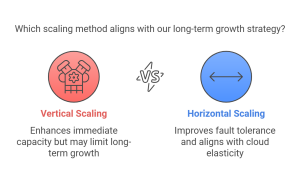
In the quest for scalability, SaaS companies face a critical decision: to scale vertically or horizontally. Vertical scaling, often referred to as “scaling up,” involves adding more power to your existing machines or servers. You beef up your existing infrastructure to handle the increased load. It’s akin to upgrading an engine to get more horsepower. While this can be a quick fix, it often leads to higher costs and potential limits in long-term expansion capabilities.
Horizontal scaling, or “scaling out,” on the other hand, involves adding more machines or servers to your pool, distributing the load across numerous resources. Think of it as adding more engines to your fleet, which can collectively handle much more than a single upgraded engine. This approach not only enhances fault tolerance and redundancy but also aligns with the elastic nature of cloud environments, making it a favored strategy in the SaaS industry.
Each approach has its merits and pitfalls, and the choice largely depends on your specific business needs, the nature of your SaaS application, and your long-term vision for growth. For many, a hybrid approach that combines elements of both vertical and horizontal scaling proves to be the most effective, allowing for flexibility and scalability as demand and technologies evolve.
Key Challenges Impacting SaaS Scaling
As SaaS companies embark on the journey of scaling, they encounter a series of intertwined challenges that can impede growth if not addressed proactively. Understanding these hurdles is the first step in developing effective strategies to overcome them.

Technical Challenges with Infrastructure and Security
Infrastructure Limitations
Scaling a SaaS application often means confronting the physical and technical limits of your existing infrastructure. As user numbers skyrocket, the underlying systems must handle increased loads without faltering. This can include challenges such as data throughput issues, latency problems, and the need for more sophisticated load-balancing solutions.
Software Bottlenecks
Even the most elegantly designed software can hit performance bottlenecks as the user base expands. These bottlenecks can arise from inefficient code, unoptimized databases, or inadequate caching strategies. Identifying and addressing these issues is crucial to ensure that the software scales smoothly alongside the hardware.
Security Concerns
With scale comes greater scrutiny—especially in terms of security. SaaS businesses must ensure that their applications remain secure against a backdrop of ever-evolving cyber threats. This means implementing robust security protocols, regular security audits, and ensuring compliance with data protection regulations, which can become increasingly complex as the business grows.
Operational Issues with Workforce and Compliance
Scaling the Team
As demand for your service grows, so does the need for a capable team to support and expand it. Recruiting, training, and retaining talent becomes more critical and challenging as the business scales. Creating a scalable team culture that can adapt to rapid changes in the business environment is vital for sustained growth.
Regulatory Compliance
Staying compliant with international data protection laws (like GDPR) and industry-specific regulations can become more daunting as a company scales. Each new market entered may come with its own set of legal requirements, adding layers of complexity to operations.
Challenges in Funding and Managing Cash Flow
Capital Expenditures vs. Operational Expenditures
Scaling a SaaS business requires careful financial planning. Decisions on capital expenditures (CapEx) like server costs, versus operational expenditures (OpEx), such as cloud services, have long-term implications on financial health and flexibility.
Pricing Strategy Adjustments
As the market dynamics shift and the business scales, so must pricing strategies. This might involve introducing new pricing tiers, adjusting rates, or offering bundled services to better align with customer expectations and market conditions.
Challenges of Innovation and Managing Product Features
Maintaining Product Quality
As features multiply and user feedback increases, maintaining the quality of the product can become increasingly challenging. Rigorous quality assurance processes and a robust framework for managing and prioritizing feature requests are essential.
Balancing Innovation and Stability
In the fast-paced SaaS industry, continuous innovation is key to staying relevant. However, balancing innovation with stability—ensuring new features do not destabilize existing functionalities—requires a delicate approach.
Challenges of Staying Ahead in a Crowded Market
Navigating Market Saturation
As more players enter the SaaS space, standing out becomes more challenging. Companies must continuously refine their unique selling proposition (USP) and ensure that their offerings remain compelling to potential customers.
Adapting to Shifting Customer Demands
Customer expectations can evolve rapidly, driven by changes in technology and competitor innovations. Staying attuned to these changes and adapting swiftly is crucial for retaining existing customers and attracting new ones.
Strategic Solutions for Effective SaaS Scaling
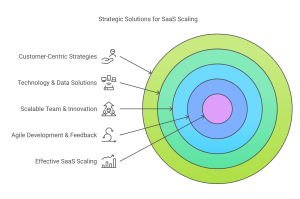
To navigate the complexities outlined in the previous section, SaaS companies must employ targeted strategies that address the immediate challenges and lay a foundation for sustainable growth.
Embracing Agile Development and Continuous Feedback
Agile Methodologies
Adopting agile development practices such as Scrum or Kanban can greatly enhance a SaaS company’s ability to scale. These methodologies support rapid iteration cycles, adaptability to changing requirements, and continuous improvement, all of which are crucial for scaling efforts.
Prioritizing User Feedback
Engagement with users through surveys, feedback sessions, and beta testing is invaluable. This direct line of communication helps inform product development and prioritize features that are most impactful to users, ensuring that the product evolves in alignment with customer needs.
Building a Scalable Team and Fostering Innovation
Cultivating a Scalable Culture
Creating an organizational culture that embraces change, values continuous learning, and encourages innovation is vital. This culture supports a scalable team structure, where members are equipped to handle the increasing pressures and challenges of a growing business.
Investing in Training and Development
Regular training and professional development opportunities can help ensure that team members grow along with the company and remain effective as the organization evolves.
Leveraging Technology for Efficiency and Security
Automating Routine Tasks
Implementing automation for routine administrative and operational tasks can free up valuable resources, allowing the team to focus on scaling efforts. This includes everything from customer service chatbots to automated billing systems, as well as marketing automation tools that streamline campaign management and customer engagement processes.
Enhancing Security Measures
As businesses scale, they become bigger targets for cyber threats. Enhancing security measures, conducting regular security audits, and staying up-to-date with compliance requirements are essential for protecting sensitive data and maintaining customer trust.
Harnessing the Power of Data and Cloud Solutions
Data-Driven Decision Making
Utilizing analytics tools to gather insights from user behavior, market trends, and internal performance metrics can guide strategic decisions, from product features to market expansion strategies.
Cloud Computing
Cloud solutions provide scalability and flexibility that traditional on-premise solutions cannot match. Leveraging cloud infrastructure and services like Amazon Web Services (AWS), Google Cloud, or Microsoft Azure can provide the necessary agility to scale resources up or down as needed.
Customer-Centric Strategies for Growth
Enhancing Customer Experience
Prioritizing customer experience is crucial for retention and growth. This involves ensuring product excellence and providing exceptional support and proactive customer service.
Building Strong Customer Relationships
Developing strong, ongoing relationships with customers through regular communication, responsive support, and community engagement can lead to higher retention rates and increase customer lifetime value.
Expanding Reach Through Strategic Marketing and Partnerships
Refining Sales and Marketing Strategies
Optimizing sales processes and marketing strategies based on data insights can help reach new customers more effectively and increase conversion rates.
Exploring Strategic Partnerships
Forming partnerships with other companies can open up new markets and customer bases, providing a significant boost to scaling efforts.
Success Stories: Learning from Effective Scaling Examples
Examining how successful SaaS companies have navigated scaling challenges can provide valuable insights and actionable lessons for others in the industry.
Case Study 1: Rapid Feature Deployment and Market Adaptation
Company A successfully scaled by implementing a robust agile development framework that allowed for rapid iteration and deployment of new features. By closely monitoring user feedback and market trends, Company A was able to quickly adapt its offerings to meet evolving customer needs, significantly enhancing user satisfaction and retention rates.
Case Study 2: Leveraging Cloud Infrastructure for Global Expansion
Company B, a SaaS provider specializing in digital marketing tools, utilized cloud computing to scale its operations globally. By transitioning to a fully cloud-based infrastructure, they managed to reduce operational costs, enhance performance, and maintain high levels of service availability across different regions, facilitating smoother expansions into new markets.
Case Study 3: Building a Scalable Team Culture
Company C focused on cultivating a scalable team culture that emphasized continuous learning and adaptability. This approach helped them efficiently manage the increased workload that came with scaling, maintaining innovation and productivity without compromising on service quality.
Summing Up Scalable Strategies for SaaS Success
Successfully scaling a SaaS business is a multifaceted challenge that requires a holistic approach. SaaS companies can navigate the complexities of scaling effectively by learning from successful case studies, embracing agile and adaptable strategies, and preparing for future challenges with a strategic plan.
At Joseph Studios, we specialize in helping SaaS companies like yours scale up by leveraging cutting-edge marketing strategies tailored to your unique business needs. Our team of experts is dedicated to ensuring that your scaling efforts are both effective and sustainable, driving long-term growth and success.
Are you ready to take your SaaS business to the next level? Book a discovery call with us today and see how Joseph Studios can help you achieve scalable success.

Maja has spent nearly a decade helping brands build authority, drive leads, and grow without relying on paid ads. With expertise in growth marketing, Generative Engine Optimization, technical SEO, and content-led growth, she turns smart content strategy into measurable business results.


