
8 Funnel-Gap Questions to Diagnose Before Your Next Marketing Budget Meeting

A digital marketing funnel is the backbone of most growth strategies. It’s how you see where customers come in, where they stick around, and maybe most importantly, where they quietly disappear. On the surface, the funnel looks straightforward. In reality, it’s messy. Prospects move forward, pause for weeks, skip steps, and sometimes fall out completely.
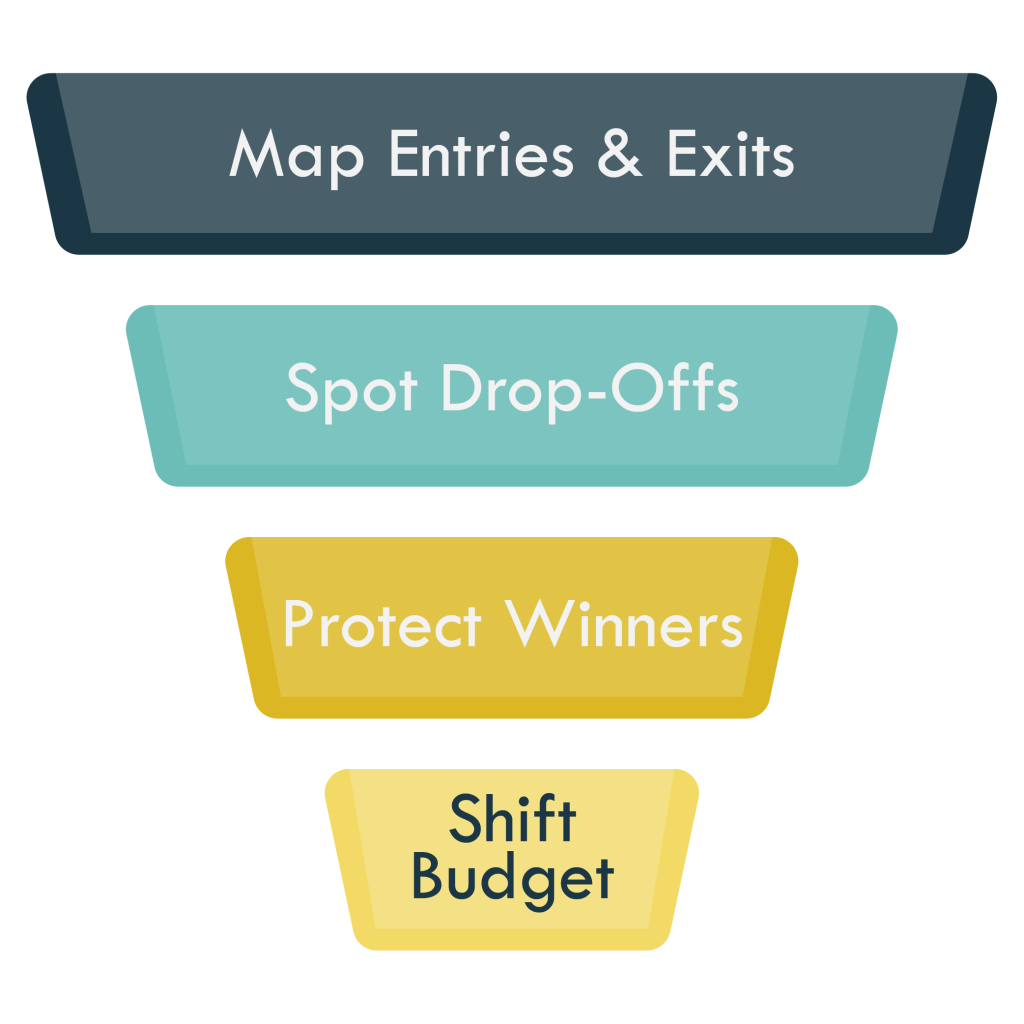
Before you next sit down with leadership to discuss where the marketing budget is going, it’s worth running a quick but honest diagnostic. Ask the right questions ahead of time to help you uncover leaks, protect high-performing stages, and reallocate spend where it matters most.
Below are eight questions to guide that review. They pull from common funnel frameworks, real-world performance metrics, and known issues when marketing and sales stop talking to each other.
1. Are we attracting enough qualified traffic at the awareness stage?
The awareness stage is the front door to your funnel, and a lot of people might be walking by without stepping inside. Metrics like impressions, branded traffic, and SEO rankings are your early warning signs.
If impressions are up but branded search volume is flat, the audience might be seeing your ads without remembering your name. Branded search volume can be tracked month over month to see if campaigns are actually sticking in people’s minds. Search rankings matter here, too, as showing up on page three for your main keywords is like putting your store in an alley.
According to studies, only 23% of marketers feel confident they’re tracking the right KPIs. That means most teams are guessing about whether top-of-funnel awareness spend is working.
2. Is our content and engagement strategy moving leads from awareness to consideration?
Getting attention is only the first move. The next is keeping it long enough for leads to care about what you sell. The middle of the digital marketing funnel, often called consideration, is where strong content earns its keep.
Your click-through rate (CTR) tells you whether ads or organic listings are compelling enough to move people forward. For context, the average CTR is about 6.6% for search ads and just 0.6% for display ads. If you’re below those numbers, the messaging may not be hitting the right note.
Another metric worth watching is how long visitors actually stick around. If they click through and leave in under a minute, chances are the page didn’t deliver what they were expecting. On the flip side, when people slow down, scroll, and start signing up for emails, registering for webinars, or grabbing a whitepaper, you know they’re leaning in.
To get more of those moments, think beyond the standard blog post. A well-built comparison chart, a customer story with real numbers, or a deep how-to guide can pull someone further into your site. And once they’re hooked, you’ve got the perfect opening to ask for that email address or get them into a nurture sequence.
3. Where are leads dropping off in the funnel, and why?
Even high-performing funnels have drop-off points. The problem is when no one knows where they are. Funnel visualization in Google Analytics can tell you which stages bleed the most traffic. You might see, for example, that a huge percentage of visitors abandon the process right after adding an item to their cart.
Knowing the “where” is step one. The “why” often requires qualitative data: session recordings, heatmaps, or even short exit-intent surveys. These can reveal issues like confusing navigation, forms that are too long, or pages that take too long to load.
According to Digital Marketing Institute research, 78% of businesses are dissatisfied with their conversion rates, and a major culprit is friction in these middle and late funnel steps. Small fixes, like clearer CTAs or simplifying checkout, can make a measurable difference.
4. Are we converting high-intent prospects efficiently at BOFU?
By the time someone reaches the bottom of the digital marketing funnel, aka the BOFU, they’ve done the homework. They’ve looked at your competitors, maybe read reviews, and perhaps even spoken to sales. Still, high intent doesn’t guarantee they’ll say “yes.”
This is where you want to watch a mix of numbers: conversion rate, customer acquisition cost (CAC), and churn rate. If CAC is creeping up while conversions are flat, you’re paying more for the same result, which is not a great sign before a budget meeting. In SaaS, this is even sharper. The first purchase isn’t the end; retention is the real finish line. That’s why free trial activation rates can be more telling than raw sign-up numbers.
If churn spikes right after the sale, that points to a mismatch between what was promised and what was delivered. Sometimes the fix is sales messaging. Sometimes it’s onboarding or customer support. Either way, these late-stage leaks cost more than most teams realize.
5. Is our budget aligned with the highest-performing funnel stages and channels?
It’s easy to throw most of the budget at the top of the digital marketing funnel. Awareness feels safe. But CPL (cost per lead) and CPA (cost per acquisition) can show a different story. If one mid-funnel campaign delivers leads at half the CPL of your top-funnel ads, why not feed more into that?
The tricky part is balance. You don’t want to starve awareness and watch your pipeline dry up. But you also can’t keep investing heavily in early-stage campaigns that never convert. Tracking “entrances” to the funnel alongside conversion rates can quickly reveal whether you’ve got volume without quality or the reverse.
A quick cross-check before budget season: Are you spending in proportion to where the funnel actually produces ROI?
6. Are our retention and loyalty initiatives generating repeat customers?
A first purchase is great. A second? That’s where profitability starts to show. Metrics like customer retention rate (CRR), lifetime value (LTV), and Net Promoter Score (NPS) will tell you if people stick around.
If the math doesn’t work — say, your average LTV is $250 but CAC is $200 — that leaves very little margin after service costs. Improving retention can flip that math without touching acquisition. Loyalty programs, member-only offers, or referral rewards can move the needle. In SaaS, retention is sometimes the difference between growing steadily and watching churn eat your gains.
And if referrals aren’t happening? That’s a flag that your “advocacy” stage needs more attention. Happy customers should be doing some of your marketing for you.
7. Do we have the right balance between paid and organic traffic sources?
Relying too much on one channel is a gamble. Paid ads can switch off the moment you stop spending. Organic channels, such as SEO, content, and earned media, build more slowly but stick around longer.
Channel-level ROI can be eye-opening. Maybe paid dominates at awareness, but organic converts better in consideration. If all your eggs are in the paid basket, a small cost spike or platform change could hit hard. According to Harvard Business School’s digital marketing data, less than a quarter of marketers feel confident in their channel mix. That means most are guessing.
You don’t have to cut what’s working. Just make sure you’ve got more than one reliable source feeding your funnel.
8. Are marketing and sales teams aligned on lead quality and handoff criteria?
Even a well-structured digital marketing funnel falls apart if marketing and sales speak different languages about leads. A marketing-qualified lead (MQL) to one team can be a “waste of time” to the other.
Lead scoring can be the glue that keeps marketing and sales on the same page. You give value to actions, maybe ten points for attending a webinar, twenty for visiting the pricing page, or thirty for asking for a demo. Once a lead hits the agreed number, it’s time for sales to step in.
Alignment is not “set it and forget it.” Review these criteria regularly. Markets change, campaigns shift, and lead behavior evolves. The teams need to evolve with it.
Put Our Funnel Expertise to Work for Your Brand
At JOS, we help brands go beyond just tracking their digital marketing funnel. We dig into the data, find the leaks, and design strategies to turn drop-offs into conversions and one-time buyers into loyal advocates.
If you’re heading into a budget meeting and want more than assumptions, we can help. Our team blends analytics with relationship-driven marketing so every stage of your funnel, from awareness to advocacy, works together to grow your business.
Contact us to learn how we can close the gaps in your funnel and make your budget work harder.

Sean Camilleri is a Digital Marketing & Growth Specialist at Joseph Studios, specializing in SEO, content marketing, and Pinterest strategy. With a background in FinTech risk management, he brings an analytical approach to organic growth — helping brands attract the right audience and turn targeted traffic into measurable results.


