
Sorry, no results.
Please try another keyword

In the fast-paced world of Software as a Service (SaaS), where the competition is fierce and customer retention is key, ensuring that your marketing and sales teams are aligned isn’t just a nice to have—it’s a necessity. Synchronizing these two powerhouses can be the secret weapon that drives sustainable growth, shortens sales cycles, and creates long-lasting customer relationships.
Unlike traditional businesses, SaaS companies often deal with a longer customer journey, highly complex products, and the constant need to foster customer engagement. Each stage of the SaaS sales cycle presents its own unique challenges, from lead generation to nurturing and, finally, retention. Misalignment between marketing and sales can result in missed opportunities, inconsistent messaging, and, ultimately, a loss in potential revenue.
By working in harmony, marketing and sales can optimize the entire customer experience—marketing brings prospects into the funnel while sales helps convert and nurture those relationships. Together, these two teams become greater than the sum of their parts, turning a traditionally fragmented process into a seamless growth machine.
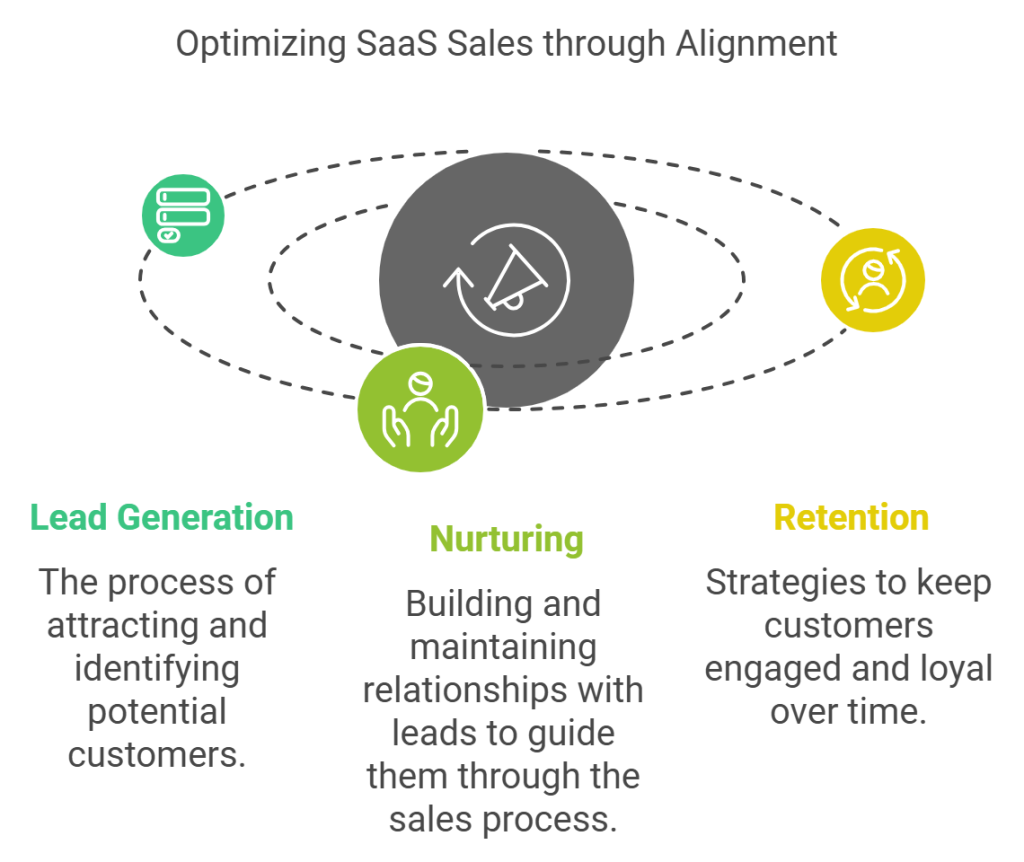
To effectively align marketing and sales, you need a crystal-clear understanding of the SaaS sales cycle—a roadmap that takes the lead from initial interest all the way to loyal customer status. The sales cycle in SaaS is more than just selling; it’s about guiding your prospects through a journey that reassures and excites them about the value of your software.

On the other hand, the SaaS sales funnel focuses on the buyer’s journey—the process that potential customers go through, from becoming aware of your solution to making a purchase decision. If the sales cycle represents what your company does to move a prospect toward becoming a customer, the sales funnel represents how the prospect experiences each stage of that journey.
The sales funnel typically involves:
The key difference is that the sales cycle concerns the actions your company takes, while the sales funnel concerns the customer’s perspective and their progression through these stages. Aligning the sales cycle and funnel ensures that marketing and sales teams always focus on the right activities and engage prospects at the right time, ultimately driving better conversions.
For marketing and sales to truly align, they need to meet at specific, high-impact touchpoints throughout the sales cycle. These intersections are where collaboration can either make or break the effectiveness of your strategy. Let’s dive into some of these key touchpoints:
Marketing plays a pivotal role in attracting potential customers—prospects who are interested in the SaaS solution offered. Using content marketing, SEO, webinars, and targeted ads, marketing generates Marketing Qualified Leads (MQLs) that are ready for the sales team to engage.
Marketing automation tools, such as HubSpot or Marketo, help automate the lead-nurturing process by qualifying leads based on their interactions. This automation ensures that leads are adequately warmed up before being handed over to sales, improving the quality and likelihood of conversion.
Content is king when it comes to enabling your sales team. Marketing needs to create and distribute content that supports the sales narrative. Case studies and whitepapers are crucial for building credibility.
When a prospect is in the consideration phase, providing data-driven case studies can be a powerful way to showcase the product’s value. Marketing should also collaborate with sales to create playbooks that include talking points, common objections, and success stories—empowering sales reps to have more impactful conversations.
A seamless transition from marketing to sales during product demos or free trials can make a big difference. Marketing must provide consistent messaging that sales can carry through in the demo. Marketing can create resources like user guides or trial checklists to ensure prospects get the most out of their trial experience, thus increasing the chances of conversion.
When a potential customer raises objections, it’s essential that sales have the right resources to respond effectively. Marketing plays a role here by equipping sales with tools to handle objections. Materials such as FAQs, testimonials, and competitive analyses allow sales reps to address concerns confidently, whether those concerns are about price, functionality, or implementation.
After the sale, marketing’s role continues. Successful onboarding requires content that guides new customers through initial product setup and adoption. Marketing and sales should work together to create nurturing campaigns targeting existing customers for cross-sell and upsell opportunities. This collaboration is essential to reduce churn and improve customer lifetime value.
Establishing shared goals and metrics is one of the most effective ways to bring these teams together. When marketing and sales are working towards the same goals—whether it’s revenue targets, customer acquisition cost (CAC) limits, or lead conversion rates—they have a common purpose that guides their efforts. Creating shared dashboards and reporting tools can be particularly useful, as it ensures that both teams have visibility into performance metrics and can make data-driven decisions together.
Regular communication and feedback loops are also vital for successful alignment. Marketing and sales teams should hold frequent sync meetings to share updates, review campaigns, and provide feedback on lead quality and customer insights. These meetings foster a culture of collaboration and keep both teams informed about what’s working and what’s not.
It’s important to ensure that insights from sales—like recurring customer objections or the most common questions during demos—are fed back to marketing. This helps refine messaging, adjust content strategies, and ultimately create more relevant, impactful materials.
Another crucial aspect is the use of sales enablement tools and resources. CRM systems, like Salesforce or HubSpot, are valuable for facilitating collaboration by providing a shared space for both teams to track customer interactions. Sales enablement platforms can also help marketing teams deliver the right content to sales reps at the right time.
Marketing should focus on creating tailored sales enablement materials, such as competitor analyses, product sheets, and battle cards, which give sales teams the tools they need to be effective during different stages of the sales cycle.
Training sessions can also be a powerful way to align marketing and sales. Marketing should educate sales teams on new campaigns, target audiences, and key messaging strategies. Similarly, sales can provide training to marketing on how customers are reacting to different approaches and what objections are coming up most frequently. This mutual education helps each team understand the other’s challenges and perspectives, fostering a more cooperative environment.
To gauge whether marketing and sales alignment efforts are successful, it’s essential to track key performance indicators that reflect both teams’ contributions to the overall business objectives.
Conversion rates at different stages of the funnel are a direct indicator of how well marketing is delivering qualified leads and how effectively sales is closing them. High conversion rates from Marketing Qualified Leads (MQLs) to Sales Qualified Leads (SQLs) and eventually to closed deals are a sign that alignment is working effectively.
Lead quality is another critical metric. If the sales team consistently reports that the leads coming from marketing are well-qualified, this suggests that the targeting and nurturing strategies are working as intended. Additionally, monitoring the length of the sales cycle can offer insights into the effectiveness of alignment—shorter sales cycles often mean smoother handoffs and more cohesive customer experiences.
Customer Lifetime Value (CLV) and churn rate are also valuable metrics for measuring alignment. If the onboarding experience is seamless and customers feel supported from the very beginning, retention rates will improve, leading to higher CLV.
Conversely, a high churn rate may indicate gaps in communication during onboarding or unmet expectations set during the sales process. Analyzing these metrics helps pinpoint areas where marketing and sales collaboration could be improved.
Finally, feedback from both teams should be gathered regularly to understand the qualitative aspects of alignment. Surveys, one-on-one interviews, or even informal discussions can provide insights into how each team feels about the collaboration process and where improvements might be needed. By combining quantitative data with qualitative feedback, SaaS businesses can gain a comprehensive understanding of their marketing and sales alignment efforts.
In the SaaS industry, the alignment between marketing and sales isn’t just a strategic advantage—it’s a necessity for sustainable growth. By synchronizing efforts, these two teams can create a unified customer journey that not only attracts high-quality leads but also nurtures them through to conversion and beyond. Implementing shared goals, regular communication, mutual training, and effective use of CRM and sales enablement tools can ensure that marketing and sales are truly working in tandem.
At Joseph Studios, we understand the challenges of achieving high conversion rates in SaaS marketing and sales alignment. Our expertise can help you bridge the gap between these two critical functions, ensuring that your strategy drives sustainable growth and maximizes ROI. Let us be your partner in creating a seamless, high-converting customer experience.
Ready to take your marketing and sales alignment to the next level? Book a discovery call with Joseph Studios today and learn how we can help you achieve your growth goals.

Sean Camilleri is a Digital Marketing & Growth Specialist at Joseph Studios, specializing in SEO, content marketing, and Pinterest strategy. With a background in FinTech risk management, he brings an analytical approach to organic growth — helping brands attract the right audience and turn targeted traffic into measurable results.

Our knowledgeable team is ready and eager to answer your questions. Want to learn more about our company and processes? Looking to explore our subscription services or discuss packaged pricing? Contact us or check out our pricing page to get acquainted.


